Cariitti Oy’s development project focused on two main areas:
- Renewing the collaborative robot cell (cobot cell)
- Researching the optimization of the fiber bundle manufacturing process for star ceiling lights
The goal was to improve production efficiency, reduce manual labor, and create solution concepts that can be utilized both in current production and in future expansions.
Technologies: Collaborative robotics, 3D printing, automation
1. Renewal of the Cobot Cell and Improved Automation
The original cobot cell was fixed in place and had technical challenges that limited the robot’s potential. The cell was originally designed to perform screwing and gluing tasks for various sauna light projectors and large lens components.
A New, Mobile and Modular Work Cell
The project redesigned the cell to be mobile—so that it can now be disassembled and assembled quickly when needed, as shown in the picture.

At the same time, a new manufacturing process for small sauna spotlights was integrated into the cell. Existing platform issues were also solved and the cobot was reprogrammed for efficient use.
User-friendly Interface and Program Switching
A user interface was developed that employees with only limited robotics knowledge can use. A key solution was a simple switch mechanism that allows safe and quick switching between the robot’s programs.

Quality Control with Artificial Intelligence
A concept was developed for the work cell in which a machine vision-based quality control system was used to screen the quality of screwing operations. An external camera and a pre-trained AI model automatically detect possible errors in production.

The Future Robot Cell – Flexible and Versatile Solution
A concept was also outlined for the robot cell of the future, in which the cobot is easily movable and workstations can be rearranged as needed. The modular solution allows the same robot to perform several different tasks—not only assembly, but also quality control, screwing, gluing, and testing.
The goal is a versatile and scalable robot cell that can quickly adapt to changing production processes and improve overall line efficiency.


Solving bottlenecks in the star ceiling light manufacturing process – Is robotics needed or can traditional design solve the problem?
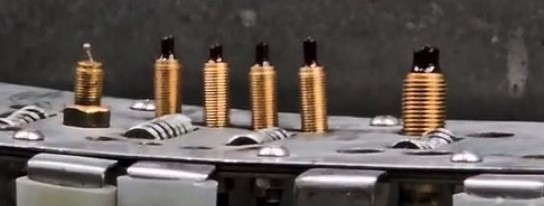
The broader goal of the project was to analyze the manufacturing process for star ceiling lights used in saunas and develop solutions to identified bottlenecks. Previously, optical fibers were handled individually at each work stage, which made manufacturing slow and laborious.
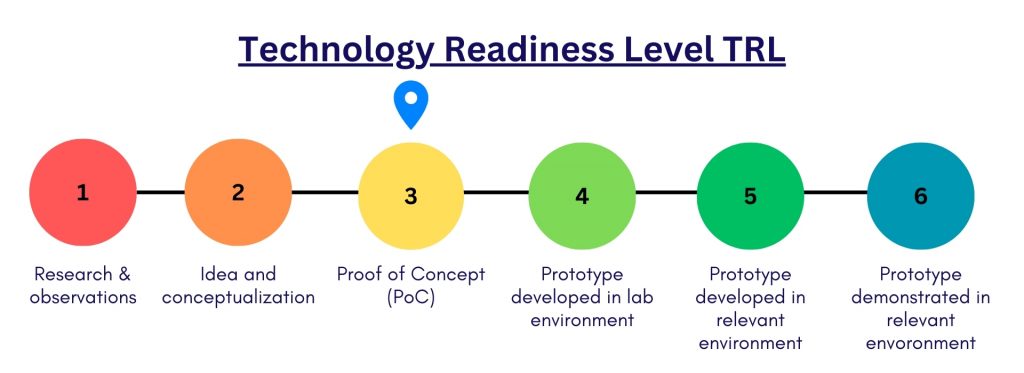
In spring 2025, based on the production process analysis.
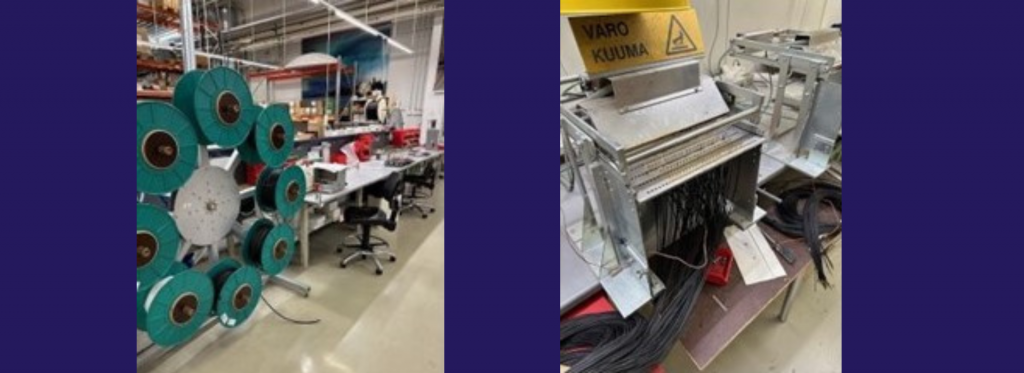
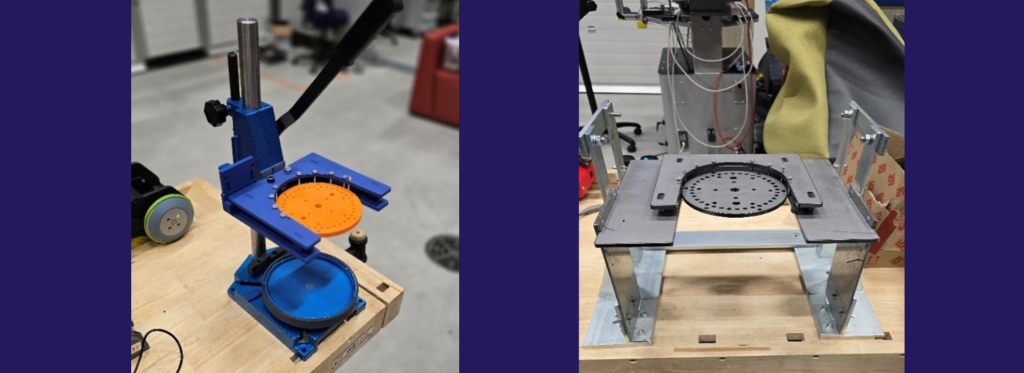
The production process was thoroughly analyzed, identifying bottlenecks such as the intermediate steps between gluing and heating. Innovative solutions were developed for these, including a jig rack that allows for consistent gluing of fiber bundles, and a vibration unit aimed at improving the capillary action during the gluing phase.
This phase of the project is supported by materials engineering students, whose work allows for a deeper investigation into the material properties of the glue and the possibility of testing optimal adhesive alternatives.
2. Process Optimization: Disc and Gluing Jig
During spring and autumn 2025, solutions were developed that eliminated major time losses in production.
Fiber Attachment Using a Disc Method
A new method uses a disc (also used in the grinding process) to which the fibers are attached at the very beginning. This eliminates the need to:
- Glue fibers one by one
- Move fibers in and out of the oven
- Reattach them to the grinding disc
This significantly speeds up the whole process.
New Gluing Jig
A gluing jig was built using the stand of a pillar drill. It enables simultaneous gluing of all fibers.
Its function is based on two phenomena:
- Dipping: fibers are dipped evenly to a depth of 2 mm
- Vibration: vibration intensifies glue movement into the fibers via capillary action
The glue is dispensed into a groove sized to the exact volume needed for a single batch.


3. Redesigning the Curing Process
Glue curing is still performed in the original oven, but its structure was updated for greater efficiency:
- The heating element was directed upwards → fibers point down so glue does not drip
- Improved insulation → reduces effects of uncontrolled airflow
- New cooling section → safe and fast cooling after curing


4. Mounting Methods
Both in the oven and with the jig, disc positioning is based on a precise 6 mm groove.
- In the oven: no mechanical fastening is needed—the weight of the disc is sufficient
- In the gluing jig: pressure plates and wing nuts are used to ensure vibration travels effectively into the fibers
Cariitti Oy
Cariitti Oy develops optical lighting solutions for industrial and residential use, with a special focus on fiber optic lighting.